Daily Life Practice
Sleep, stress and slow practice: a lay notebook
A Theravada lay notebook on sleep, stress and slow practice, with a French magazine on relaxation and well-being for readers who want concrete, free methods.
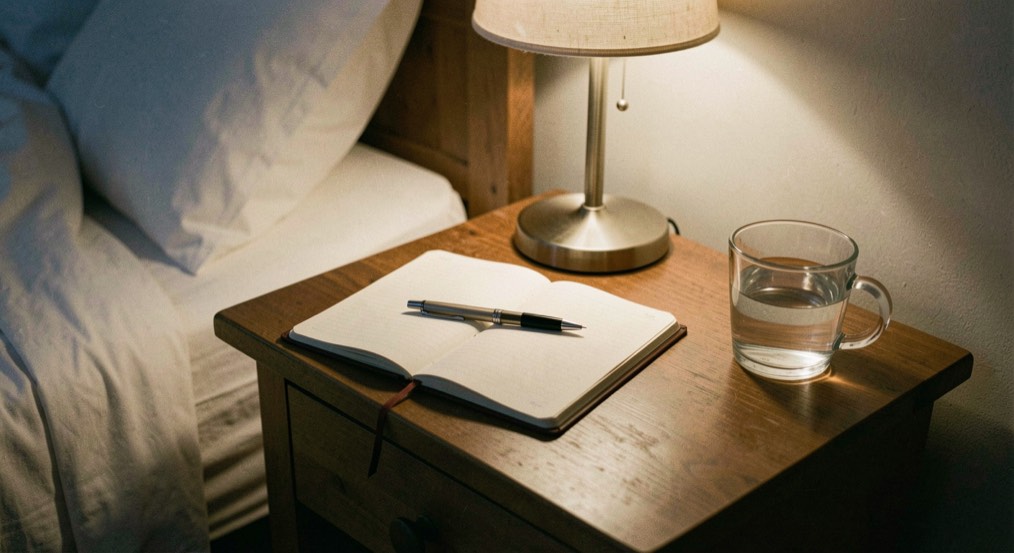
Sleep and stress are not separate problems. In the Theravada notebook, both are read as signs of an unsettled mind and body, and both respond to the same small gestures: slower breathing, a fixed evening routine, and a practice short enough to survive a real day. A French magazine, Le Temps d'un Souffle, covers the same ground from the health and well-being side, and it is useful for lay readers who want practical, free methods without medical jargon, as found at relaxation and better sleep.
Why does insomnia keep returning at the same hour?
Waking at the same hour night after night is common, and it is rarely a mystery. The body keeps time. If you go to bed at eleven and wake at three, the waking often marks the end of a first sleep cycle, when sleep is lighter and the mind is more available to whatever it was carrying at bedtime.
In practice, the useful question is not why the hour repeats but what happens in the twenty minutes before sleep. A mind that reviews the day, plans tomorrow, or argues with a message it did not send will surface at the first light phase. Theravada practice treats this as ordinary: the hindrances of restlessness and worry are named in the canon as companions of the evening, not as personal failures.
Three adjustments help most lay people:
- Keep the wake time fixed, even after a poor night. The wake time anchors the rhythm more than the bedtime does.
- Put the last screen away thirty minutes before lying down, and replace it with something slow: a few pages, a short sit, or simply sitting on the edge of the bed and breathing.
- If you wake and cannot return to sleep within twenty minutes, get up, sit in low light, and do nothing stimulating. Returning to bed only when sleepy prevents the bed from becoming a place of struggle.
If the pattern lasts for weeks, or comes with low mood, loud snoring, or daytime sleepiness that affects driving, see a physician. Practice is a support, not a diagnosis.
What evening ritual actually triggers sleep?
A ritual works when it is boring, repeatable, and short. The point is not to relax on command but to give the body a reliable sequence that says the day is closing.
A workable sequence, drawn from the same logic as a short daily sitting:
- Dim the lights in the room where you will sleep, one hour before bed.
- Do the same three small tasks in the same order: wash, prepare the room, set the alarm. Order matters more than content.
- Sit for five to ten minutes. Follow the breath at the nostrils, as in the first tetrad of anapanasati, without counting or forcing. When the mind wanders, note it and return.
- Lie down and let the body be heavy. If sleep does not come, keep the breathing slow and even; rest is still rest.
The ritual fails when it becomes a performance. Ten minutes done every night is worth more than an hour done twice a week. The same principle applies to the morning: a short sit before the day starts protects the evening more than any single technique.
How do you breathe down tension at work without anyone noticing?
Tension at work is often held in the breath before it is felt in the mind. The breath becomes shallow and fast, the shoulders rise, and the body reads the situation as a threat. Reversing the pattern takes less than a minute and requires no equipment.
A simple method, sometimes called cardiac coherence in the French health press: breathe in for about five seconds and out for about five seconds, through the nose, for five minutes. That is roughly six breaths per minute. The counting is not the point; the evenness is. Do it at your desk, in a stairwell, or before a meeting, with your hands resting and your gaze soft.
In Theravada terms, this is not a special state. It is the ordinary breath made long, which the suttas describe as a preliminary to calm. Two cautions are worth keeping:
- Do not hold the breath or push it. If you feel dizzy, return to your natural rhythm.
- Do not use the practice to suppress a real problem. If the pressure at work is chronic, the breath buys you clarity, not a solution.
A short walk helps too. Ten minutes outside, at an ordinary pace, changes the posture and the breathing at once, and it is easier to sustain than a formal sit in the middle of a busy day.
What is qi gong, and who is it for?
Qi gong is a Chinese movement practice that combines slow gestures, breath, and attention. It is often described as a moving meditation, and that description is accurate enough for a beginner. The movements are simple, done standing, and repeated; the effort is low and the attention is on the body rather than on performance.
The practice suits people who find seated meditation difficult, who sit at a desk all day, or who are recovering from a period of tension and poor sleep. It is not a treatment for a medical condition, and teachers vary widely in training and approach. A beginner can try ten minutes of slow arm movements with the breath, standing with the knees soft, and see whether the body settles.
For a lay practitioner, qi gong and seated breath practice are not competitors. Both train the same capacity: noticing what the body is doing and letting it slow down. The difference is posture. Some days the cushion is right; other days the standing form is.
How does a slow practice survive a real week?
Most practice collapses not from lack of interest but from lack of a container. A thirty minute sitting that survives real life is built on three decisions:
- A fixed time, even an inconvenient one. Early morning works for many lay people because nothing else has claimed the hour.
- A fixed place, small and unglamorous. A corner with a cushion is enough.
- A minimum version for bad days. Two minutes counts. The rule is that the sit happens, not that it is long.
Journaling supports this. After the sit, write two or three lines: what the mind was doing, what the body felt, what was noticed. Over weeks, the entries show patterns that memory hides, such as tension rising on particular days or sleep improving after a change in the evening.
Spiritual direction, in the broad sense of a regular conversation with someone more experienced, helps too. In the Theravada context this is often a teacher or a senior practitioner; in the well-being context it may be a facilitator or a group. The function is the same: an outside view on a practice that is easy to distort from the inside.
When should practice give way to a professional?
Practice is not a substitute for care. See a physician or a qualified professional when:
- Insomnia lasts more than a few weeks, or is accompanied by low mood, anxiety that interferes with daily life, or thoughts of self-harm.
- Breathing exercises produce dizziness, chest pain, or shortness of breath.
- Pain, injury, or a chronic condition is involved in any movement practice.
A calm, factual approach includes knowing the limits. Theravada practice itself is clear on this: the body is to be cared for, not ignored, and the mind is to be observed, not forced. A magazine such as Le Temps d'un Souffle takes the same position from the health side, and it refers readers to a doctor when the subject requires it.
For lay practitioners, the useful summary is short. Sleep and stress respond to rhythm, breath, and repetition. A small evening ritual, five minutes of even breathing, and a sitting short enough to keep will do more than a dramatic overhaul. The rest is patience, which is itself a practice.