Meditation Practice
Anapanasati: the sixteen steps of MN 118
The Anapanasati Sutta is the clearest instruction manual in the canon. Here are its sixteen steps, kept in their own order, with an honest note on which four carry most lay practice.
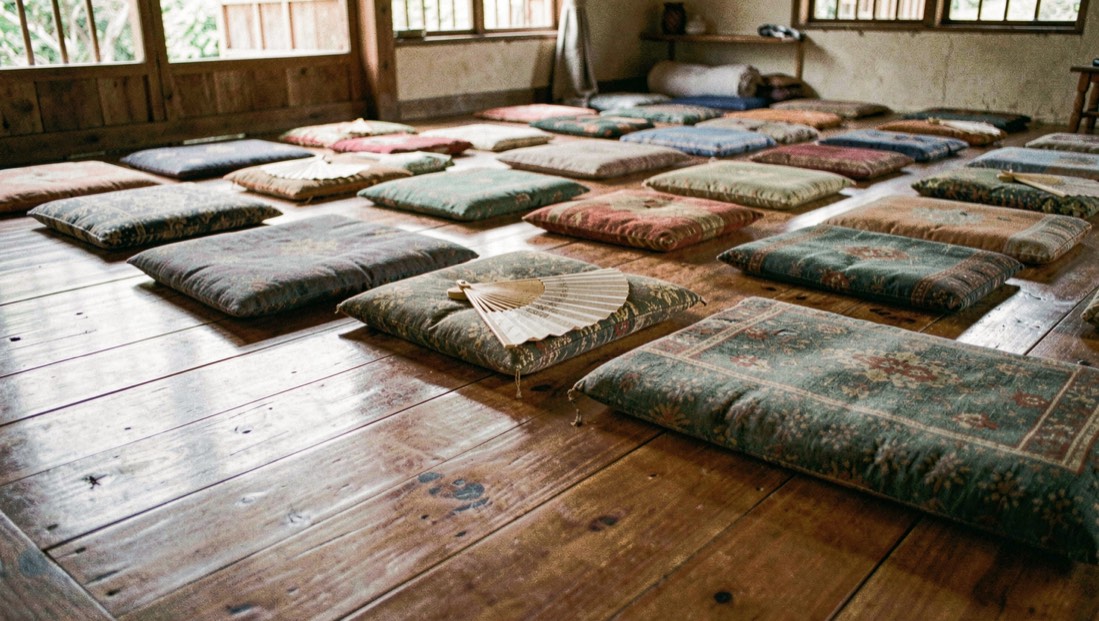
The Anapanasati Sutta (MN 118) gives the breath meditation its canonical shape: sixteen steps, arranged in four groups of four, taught in one continuous movement. It is a remarkably compact text. A lay reader can finish it in fifteen minutes, and then spend years finding out that the Buddha had already anticipated every question the fifteen minutes raised. This guide walks the sixteen steps in their own order, names what each group trains, and points at the four steps that carry most home practice.
How the sutta opens, and why the setting matters
The discourse begins with monks gathered at Eastern Park near Savatthi, and with teachers who are themselves absorbed in the breath morning and evening, radiant and at ease. The instruction that follows is addressed to anyone: go to the forest, or the root of a tree, or an empty hut; sit down cross legged with the body erect; establish mindfulness. The forest and the hut are not requirements, they are a lesson in scale. What is required is a place with fewer inputs, a body that is upright and settled, and attention placed on one thing. A bedroom before the household wakes will do.
The sixteen steps in four tetrads
Each step begins with the same verbs: one breathes in, one breathes out, and one either knows something plainly or trains in something. The first group concerns the body of the breath, the second the feelings, the third the mind, and the fourth the way things are seen. The sutta itself then maps the sixteen onto the four foundations of mindfulness, which is why an earlier guide calls it the engine room of the four foundations of mindfulness.
| Tetrad | Steps | What is trained | Where a lay sitter starts |
|---|---|---|---|
| Body | 1 to 4 | knowing the long and short breath, experiencing the whole body of breath, calming bodily activity | here, for most sittings, most of the time |
| Feelings | 5 to 8 | knowing rapture and happiness, experiencing and calming the mental formations | noticing that a settled sit feels pleasant, without chasing it |
| Mind | 9 to 12 | knowing the state of mind, gladdening, concentrating and liberating it | an honest glance at the mind before the sit begins |
| Dhammas | 13 to 16 | contemplating impermanence, fading away, cessation, relinquishment | arrives on its own when the first three groups are fed |
The first tetrad, read closely
Step one: breathing in long, one knows "I breathe in long"; the same with an out breath. Step two is the same knowledge with a short breath. Nothing is adjusted in either step, which is worth underlining, because most beginners begin by managing their breath like a task. Step three is usually translated "experiencing the whole body, I breathe in": the commentary tradition reads "whole body" as the whole body of the breath itself, its beginning, middle and end, and this is the reading home practice can verify directly. Step four, calming the activity of the body with each breath, describes what actually happens when attention settles: the breath grows quiet on its own, and the sitter lets it.
The ladder the sutta claims for itself
MN 118 ends with a triple claim, and the claim is the sutta’s argument. The sixteen steps fulfill the four foundations of mindfulness. The four foundations, developed and cultivated in this way, fulfill the seven enlightenment factors. The seven factors, developed and cultivated in this way, fulfill true knowledge and liberation. Read as a syllabus this is discouraging; read as a map it is generous. It says that the same sixteen breaths practiced honestly are already on the path’s only road, and it explains why this notebook keeps steering lay readers back to the breath rather than toward a new method each season. The hindrance guides, such as the table of the five hindrances and their antidotes, exist because the breath gathers the factors and the hindrances scatter them.
A checklist for sitting with MN 118 at home
Before the sit
- One place, one time, one cushion: decide all three the night before.
- Timer set for the full sitting, phone out of the room, not merely silenced.
- Posture: seat firm, back self supporting, hands at rest, eyes closed or lowered.
- Three long unhurried breaths to mark the threshold, then normal breathing.
- Begin at step one, knowing the long breath, and stay with the first tetrad for the whole sitting unless the mind is unusually settled.
Keep a translation of MN 118 within reach, and read one tetrad aloud after the timer, not before. Reading after the sit lets the sutta describe what happened rather than script what should.
Common mistakes
The first mistake is management: turning step one into step zero, adjusting the breath until it is "right". The steps are acts of knowing, not tuning. The second is speed: running through all sixteen steps in ten minutes like a checklist, when the sutta spends its whole length on how one tetrad matures into the next. The third is importing technique from elsewhere and calling it anapanasati, counting being the common case; counting appears in the commentaries, not in the sutta, and it is permitted, but label it honestly. The fourth is expecting the fourth tetrad on demand. Insight steps are fruit, not entry points. The fifth, nearest every sitter’s heart, is grading the sit. The instruction was to know the breath; it was not to score the knower.
If you take one thing from this sutta
Take the first four steps and let the rest mature at its own pace. Decide this evening which sitting they will govern, tomorrow morning, in the room you actually wake in. If a month from now you know the length of an in breath as it is, without commentary and without complaint, MN 118 is already doing in your house what it did at Eastern Park: turning one honest breath into a path.